
How to Arrange Wedding Guest Transport in Portugal
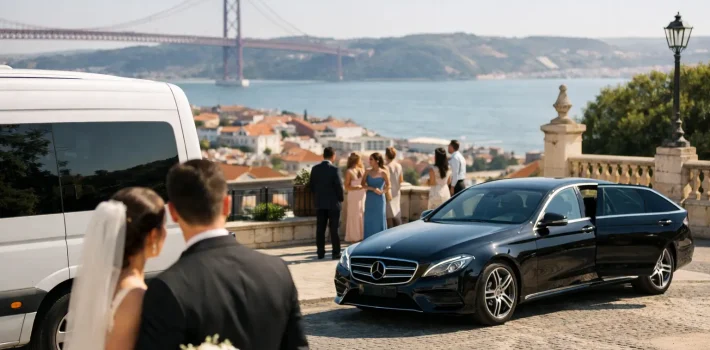
A wedding at a Lisbon palace, a vineyard in the Douro Valley, or a coastal venue in Cascais should begin with guests arriving relaxed, on time, and ready to celebrate. To arrange wedding guest transport well, treat it as part of the guest experience, not a last-minute journey between hotel and venue. A clear transport plan saves guests from unfamiliar roads, limited parking, late-night driving, and the worry of finding a taxi when everyone leaves at once.
For destination weddings in Portugal, private transport also gives hosts a practical way to look after family and friends who have traveled a long way to be there. The best plan is rarely the largest or most complicated one. It is the one that matches your group, your venue, and the rhythm of your day.
Start With the Journeys That Matter Most
Before choosing vehicles, map every journey your guests may need. Most weddings need more than a single hotel-to-venue transfer. International guests may arrive at Lisbon Airport at different times, stay in more than one hotel, attend a welcome dinner, and need a comfortable return journey after the reception.
Begin with the moments where transport has the greatest effect: airport arrivals for close family, transfers for the wedding party, transport to the ceremony, and return service after the celebration. If your venue is outside central Lisbon, in Sintra, Cascais, Comporta, the Alentejo, or another countryside location, this planning becomes especially valuable. Rural properties are beautiful, but they may have narrow access roads, limited lighting, and few reliable local taxis after midnight.
Ask your venue for exact vehicle access details. A historic estate may have a steep driveway or a turning area that suits luxury people carriers but not a large coach. A beach venue may have a designated drop-off point that is a short walk from the ceremony area. These details shape the vehicle plan and prevent awkward surprises on the day.
Arrange Wedding Guest Transport Around Real Guest Groups
Do not assume every guest has the same needs. A couple traveling light from a hotel near the venue needs something different from grandparents arriving with checked luggage or parents traveling with young children.
For small groups, private Mercedes V-Class people carriers are often an excellent choice. They offer comfortable space for up to six passengers with luggage and allow guests to travel together without the crowding or fixed timetable of a large coach. They are particularly useful for family groups, the wedding party, or guests who need door-to-door assistance.
Mercedes E-Class sedans suit couples, solo travelers, and VIP transfers, while an E-Class estate car can be useful where additional luggage space matters. Vehicle selection should account for people, bags, child seats, and the distance involved. A vehicle that is comfortable for six guests on a 20-minute city transfer may not feel as pleasant for a longer journey to the Algarve or Douro Valley when everyone has formalwear and luggage.
It can be tempting to group everyone into the fewest possible cars. That may lower the initial cost, but it can create delays when guests are staying at several hotels or are not ready at the same time. Smaller, well-timed transfer groups usually feel more personal and keep the schedule moving.
Prioritize Guests Who Will Benefit Most
A full transport plan for every attendee is not always necessary. If many guests are staying in central Lisbon and your venue is nearby, you may choose to arrange transport for only the wedding party, older relatives, families with children, and anyone staying farther away.
For a late reception, return transport deserves special attention. Guests should not feel they need to leave early because they are concerned about driving or finding their way back. Consider scheduled departure waves, such as an earlier option for families and a later one for guests who want to enjoy the party until the end. For very small groups, a private return service may offer more flexibility.
Build a Timeline With Breathing Room
Wedding-day travel schedules need more margin than an ordinary airport transfer. Hair, photographs, elevator waits, unfamiliar hotels, and last-minute outfit adjustments all take time. A driver can be punctual, but guests still need a realistic collection time.
Work backward from the ceremony. Confirm when guests should be seated, then allow time for the walk from drop-off to the ceremony location, possible security or venue entry, and a comfortable buffer. For a countryside wedding, add time for traffic leaving Lisbon and for slower roads near the venue. If the ceremony begins at 4:00 p.m., a 3:50 p.m. arrival may be technically possible but is not a welcoming plan.
For the wedding party, separate transport can be worthwhile. The couple, parents, bridal party, and photographer may each need different arrival times. Keeping these groups independent reduces the chance that one delayed person affects everyone else.
You should also plan for the end of the night with the same care. Confirm the latest collection point, the contact person at the venue, and whether guests can request an earlier departure. If alcohol will be served, dependable chauffeured transport is a responsible choice as well as a comfortable one.
Give Guests Clear, Simple Information
Your guests do not need a complicated travel document. They do need certainty. Send transport details in advance, ideally alongside the wedding itinerary, and repeat the essentials shortly before the event.
Include the pickup location, pickup time, the name or description of the vehicle, and a contact number for the day. If guests are meeting at a hotel lobby, say exactly where. If there are several departures, make it clear which group each guest is assigned to. Avoid vague instructions such as “transport will be available after dinner.” A scheduled departure time is far more reassuring.
For overseas visitors, it is helpful to mention that Portugal uses local time and to advise guests to keep their phone charged. If guests are being collected from Lisbon Airport, explain the meeting procedure clearly, particularly for travelers arriving from outside the European Union who may need longer for passport control and baggage collection.
A single designated coordinator is invaluable. This may be a wedding planner, a trusted family member, or a member of your venue team. The transport provider should have that person’s phone number, while guests should know whom to contact if they cannot find their pickup point.
Share the Details Your Chauffeur Needs
Professional transport works best when the operator receives accurate information early, followed by final confirmation close to the wedding date. Provide hotel names and full addresses, guest numbers for each journey, luggage expectations, ceremony and reception timings, and any special requests.
Be sure to mention mobility needs, child seats, folding wheelchairs, or guests who may need help getting in and out of the vehicle. This is not an inconvenience. It allows the chauffeur team to select suitable vehicles and provide attentive assistance without rushing anyone.
It is also wise to flag language needs and international phone numbers. English-speaking chauffeurs can be especially reassuring for guests who are visiting Portugal for the first time. Beyond driving, a thoughtful local chauffeur can help guests feel oriented, offer practical recommendations, and keep the tone relaxed when plans change.
At NickiTravel, wedding transport can be coordinated as part of a wider private travel plan, from Lisbon Airport arrivals and welcome dinners to post-wedding sightseeing or onward journeys across Portugal. This is particularly helpful when guests have varied travel schedules and hosts want one knowledgeable local team to keep track of the moving parts.
Think Beyond the Ceremony
A destination wedding is often a small vacation for your guests. The days around the celebration are an opportunity to make their stay more enjoyable without overfilling the schedule. A private transfer can connect a welcome dinner in Lisbon with a hotel in Cascais, collect a family for a day in Sintra, or take a small group from the wedding venue to their next Portuguese destination.
There is a balance to strike. Not every hour needs an organized activity, and guests will appreciate free time. But airport transfers for key family members, a shared excursion for interested guests, or a comfortable departure journey can make the entire occasion feel considered.
When you arrange wedding guest transport with care, the result is more than punctual arrivals. It gives your guests permission to settle in, enjoy a glass of Portuguese wine, stay present for the celebration, and remember the welcome as warmly as the wedding itself.